Dreams About Cats — What They Might Mean
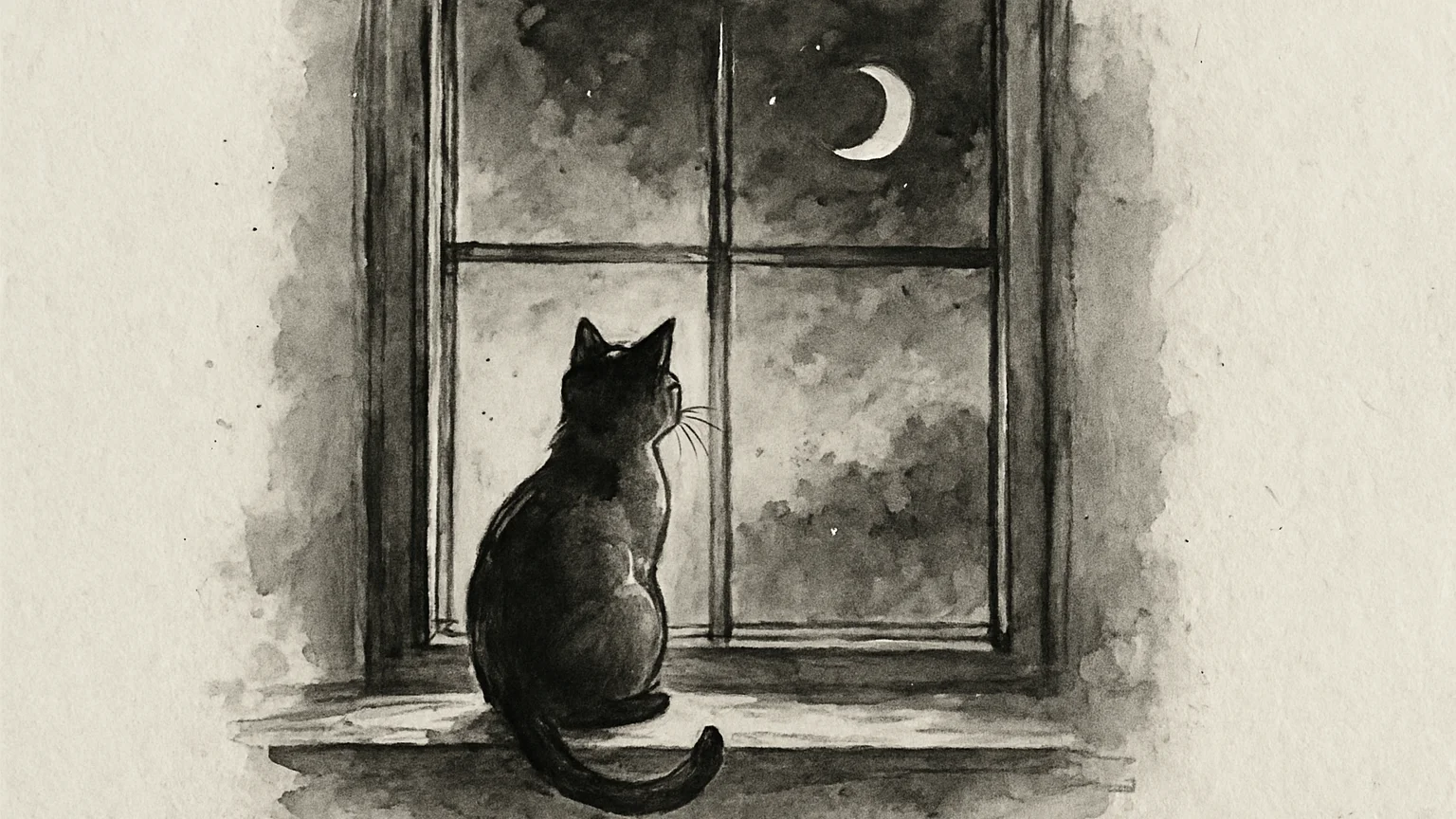
Cats are the dream world’s other household animal, and they run on the opposite engine from dogs: autonomy instead of loyalty, presence without possession. Cat dreams tend to arrive when affection is running on terms — yours or someone else’s — and when something in the house of your life is felt but not seen.
What this dream might be about
Put this page next to the dog page and the two animals define each other. The dog is the animal that made itself ours; the cat is the animal that moved in and kept its own government. It lives in your house without quite belonging to you, loves you in a currency it alone mints, comes when called if the call happens to align with its plans — and dreams use it accordingly. Where a dream-dog measures loyalty, a dream-cat measures terms: the state of everything in your life that is present but not possessed, close but not commanded. Which turns out to be a lot.
Most often, that’s a relationship. Cat dreams keep company with affection that stays voluntary — and with the ache of that voluntariness. Everyone has someone whose warmth arrives on its own schedule: the partner whose closeness can’t be summoned, the parent whose approval visits like weather, the friend who loves you and cannot be pinned to a plan, the grown child on their own orbit. A dream-cat curled against you carries the specific sweetness of chosen closeness — worth more, the dream knows, precisely because it can’t be compelled. And a dream-cat crossing the room past your outstretched hand carries the other thing. If a cat dream left you with a feeling, it’s worth asking who in your waking life dispenses their nearness on exactly that schedule.
Just as often, the cat is inside you. Everyone keeps a domesticated self — the one that comes when called, meets the deadlines, performs the warmth — and everyone keeps the other one: the self with private appetites and non-negotiable terms, the one that will do almost anything except be made to. Dreams reach for the cat when that second self needs representation: in seasons of heavy obligation, over-scheduled devotion, too much coming-when-called, a cat will simply appear in the dream and do what cats do — exempt itself. Dreamers often report an odd, guilty admiration watching it. That admiration is the message. Something in you is watching the one creature in the dream that never obeys, and taking notes. (The dictionaries will add, reflexively, that the cat is the feminine — a reading with a long history and the same weakness as the spider’s mother: pre-installed, and pasted over every cat equally. If it fits your night, use it. As a default, behavior first.)
And then there’s the cat’s strangest job in dreams, borrowed straight from life: staring at what you can’t see. Every cat owner knows the moment — the animal fixed, ears forward, on an empty corner — and the small chill it hands the room. Dreams recruit this constantly. The cat is the dream’s instrument for the felt-but-unseen: it notices before you do, watches the doorway you’d dismissed, refuses to enter the room that looks fine. A cat behaving this way in a dream is often the sensing part of you, given fur — the intuition that has registered something in a situation, a person, a house of your life, that the daytime mind hasn’t been persuaded to look at yet. The dream isn’t saying something is there. It’s saying something in you thinks so — and has been staring at it for a while.
The cat carries all of this at once. Which part it carried into your night is in what the cat did, whose terms held — and what it was looking at.
A cat that scratches or turns on you
The signature is the suddenness: purring under your hand, and then — the turn, the claws, the correction, over in a second. Cat violence in dreams is close-range and conditional, which is the reading: this isn’t the dog’s broken contract but a boundary, enforced — the feeling of having pushed past someone’s terms, stayed too long in a welcome, mistaken tolerance for permission. Or the reverse, from the paw’s side: your own limits, finally drawing blood after too much stroking. Dreamers usually know, on waking, which end of the claw they were on. The scratch stings out of proportion to its size in these dreams — and so does the waking version it’s rendering.
A cat that won’t come to you
You call; it looks at you; it stays where it is. Or it lets you approach to exactly one step short and relocates. No aggression, no drama — just distance, administered with total calm, and the dream’s peculiar power to make that small refusal ache. This version tends to visit when a specific warmth in waking life has gone conditional or receded: intimacy that’s cooled by a degree, approval withdrawn without incident, someone still present but no longer arriving. Sometimes the unreachable cat is a part of yourself — ease, playfulness, desire — that has stopped answering. The dream renders withdrawal with perfect economy: nothing is wrong, nothing is said, and the cat simply doesn’t come.
A cat staring at something you can’t see
The dream’s chill in purest form — the animal fixed on an empty corner, a dark hallway, the space just behind you, and refusing to be called off. As above, this is the intuition dream: something registered but not yet admitted, and the cat is the part of you that won’t stop looking at it. The direction matters and dreamers usually remember it — what the corner was near, which room, which door. It’s worth sitting with what, in your waking life, occupies that direction. This version doesn’t say the fear is founded. It says the noticing is real, and it’s been standing there with its ears forward for some time, waiting for you to follow its gaze.
A house full of cats
Cats on every surface, more in each room, appearing faster than counting. Unlike the spider infestation, this one usually isn’t horror — dreamers report something closer to bemused overwhelm, occasionally delight tipping into unease. The many-cat dream tends to trade in accumulated terms: a life filled with presences that each demand accommodation on their own schedule — commitments, relationships, roles, every one individually manageable, collectively ungovernable. It’s overwhelm’s softer dialect: not the world become unwalkable, but the house become a negotiation. Count anyway. The dream usually knows roughly how many un-commandable things you’re currently hosting — and it made you feed all of them.
Your cat, lost — or returned
The literal cat, the one from your actual life: slipped out a door, gone from its spot, missing in the dream’s specific rising panic — or the other one, the cat who died, back on the windowsill, asleep in the old shape, no explanation given or needed. Both belong to the same family of dreams the dog page holds at length: the caretaking rehearsal and the grief visit, and everything written there holds here — the clustering when stakes are live, the first-year density of the returning dead, the way those visits soften over time from ache toward company. Cat grief gets less social permission than dog grief, and the dreams don’t care: they come just as often, just as vividly, and they need decoding just as little. Some dreams are only love, keeping the old appointment.
Kittens — especially found ones
The dream hides them and lets you discover: a litter behind the shed, in a closet, in a drawer that shouldn’t hold anything alive — tiny, eyes barely open, suddenly yours. Where puppy dreams announce new responsibility, kitten dreams trade in the discovered delicate thing: something small, new, and easily harmed that has appeared in your life’s hidden corner and now needs deciding about. A talent just noticed. A feeling in its first weeks. An idea too young to defend itself. The dream’s question is in your hands’ response — did you reach in, or close the drawer quietly? Found kittens are the dream’s way of saying something fragile has started, somewhere you weren’t looking. It survives on what you do next.
What matters more than the symbol
Here is the honest limit of a page like this one: the same cat plays a different part in every dream it enters — and like the dog, it may not be playing a part at all. A stranger-cat staring down a dark hallway is not your cat asleep in the crook of your knee, and neither is the one who died last spring, back on the sill in the old noon light. A field guide can tell you the breed, the posture, what the flattened ears mean. It cannot tell you why the cat was watching that corner — or why it finally came to you, this time, without being called.
No one can tell you what your dream means — including us. What the cat was doing in your night depends on everything around it: whether you knew it, whose terms held, what it watched and wouldn’t stop watching, and what you felt when it looked at you — or didn’t. Those are the details the dictionaries can’t see, and they’re yours.
Before you go looking for meaning
One practical note. If a cat shares your home, it is almost certainly editing your dreams in person. Cats keep the night shift — they walk the bed at 4 a.m., knead the blanket over your legs, purr against your ribs, and stage their loudest opinions in the hour before dawn, which happens to be prime dreaming time. Sleeping minds weave the bedroom in, so cat owners dream cats at the highest rate of any pet keeper, frequently starring the actual animal currently standing on their chest. And as with dogs, grief runs its own honest schedule: in the months after losing a cat, these dreams aren’t a mystery — they’re the expected weather of a house with one warm spot missing. So, the census before the symbol: is there a cat on the bed, or a cat-shaped silence in the house? Not every cat is a message. Some are just the one who’s actually there — walking across you, right now, at the exact moment the dream got strange.
Frequently asked questions
What does dreaming about cats usually mean?
Where dogs are the dream world's language for loyalty, cats are its language for autonomy — affection that stays voluntary, presence without possession. The pattern most often reported ties cat dreams to exactly that territory in waking life: relationships running on their own terms, and the parts of yourself that won't be governed. As with dogs, check the literal reading first: was this a cat, or your cat?
Is a black cat in a dream bad luck?
Folklore can't agree, which is the honest answer — black cats are ill omens in some Western traditions and good fortune in others: lucky in Japan, lucky for British sailors' wives, lucky to encounter in parts of Europe. Dreams don't deal in luck either way. If the black cat came with a charged atmosphere, take the atmosphere seriously; the color chart, as ever, mostly cancels itself out.
What does it mean if a cat attacks or scratches me in a dream?
Cat aggression in dreams has a specific signature — it's usually sudden, close-range, and follows contact: the purring animal that turns mid-stroke. It tends to trade in boundaries rather than betrayal — the feeling of having pushed past someone's terms, or of someone pushing past yours, and the sharp correction that followed. It isn't an omen, and it isn't evidence about anyone.
Why did I dream about my cat who died?
For the same reason people dream their dead dogs, and just as often: grief dreams, and it dreams the ones who shared our rooms. Dead cats tend to return well — young, whole, asleep in the old spot, no explanation offered — and most people wake comforted. It isn't a haunting or a wound reopening; it's love keeping the shape of what it loved. These dreams cluster in the first year and revisit around anniversaries.