Dreams About Spiders — What They Might Mean
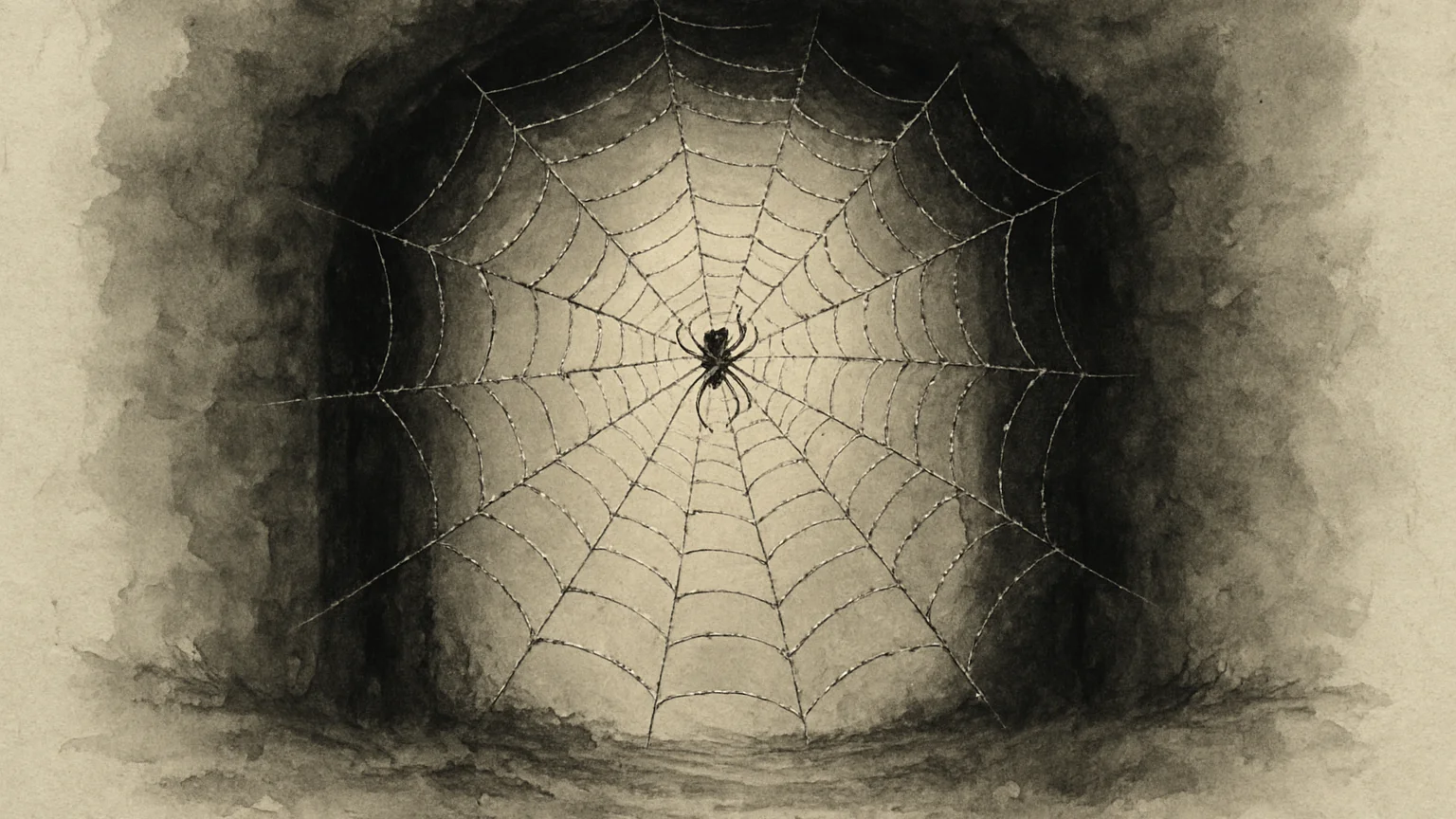
Spiders are among the most dreamed — and most dreaded — animals there are, and dreaming of one isn’t a warning or an omen. Spider dreams tend to come when something feels sticky, watchful, or quietly closing in — and as with snakes, what the spider was doing matters more than the spider.
What this dream might be about
Start with the spider’s strangest property as a threat: it doesn’t chase. Nearly every other fear the dream world employs comes toward you — the pursuer, the wave, the closing doors. The spider just is somewhere, high in a corner, still, and lets you do the approaching. Its whole strategy is patience and placement, and dreams use it accordingly: a spider in a dream is rarely an attack. It’s a presence — something that got into the room before you did, watches without hurry, and has already built its position while you weren’t looking. If the snake is the threat at ankle height, the spider is the one at the edge of vision, and the dread it carries is the dread of being outwaited.
Then there’s the web, which is often the dream’s real subject with the spider as mere signature. Webs are the mind’s perfect image for a certain kind of waking situation: structures made of almost nothing — small threads, small yeses, small debts — that are individually weightless and collectively inescapable, and always stickier on the way out than the way in. The overcommitted calendar. The favor economy at work. The relationship, or family system, where every strand is thin and there are forty of them. Dreamers who walk through webs, pull them from their hair, or find them across every doorway are usually dreaming about that texture — entanglement — and the spider barely needs to appear. Someone built this, the web says. And you’re in it.
Which raises the dream’s quieter question: who’s the spider? Not every night casts you as the fly. Spiders are also the animal kingdom’s great makers — patient, structural, spinning architecture out of themselves — and some spider dreams sit closer to craft than to fear: watching one build, or finding an intricate finished web where nothing was yesterday. If your waking life involves long, careful construction — a project, a case, a plan laid strand by strand — the spider may be on your side of the glass. (The dictionaries will also tell you, insistently, that the spider is your mother — a reading psychoanalysis wove a century ago and the copy-paste books have repeated since. If a specific web of family obligation is where the dream took you, the reading might earn its keep. As a default, treat it like the color charts: pre-installed, and canceling out across books.)
And sometimes the spider is doing what fear itself does: commanding a room at a thousand times its size. A creature that could sit on a coin can empty a house — the dream knows this is absurd and stages it anyway, because it’s precisely how certain waking worries operate. Small, still, in the corner, and somehow governing everything: the unopened letter, the unspoken conversation, the appointment unbooked. A spider dream in that register isn’t about the spider at all. It’s about the disproportion — the tiny thing that has been given the whole ceiling.
The spider carries all of this at once. Which part it carried into your night is in what it did, where it built, and what you did back.
A spider crawling on you
Contact — the corner presence suddenly on your skin, usually an arm, the neck, the back of a hand, with that specific delicate horror of being walked on by something you didn’t grant. This version collapses the spider’s whole strategy of distance in one move, and it tends to visit when something watched-from-afar has recently gotten personal: the workplace tension that reached your name, the family matter that arrived at your door, the worry that stopped being abstract. The lightness of the touch is the point. It got that close, and you never felt it coming.
Bitten by a spider
Different from the snake’s strike, and the difference is the meaning. Snakebite is an event; spider bites — in life and often in the dream — go unfelt and announce themselves later, a swelling where something small already happened. This version tends to trade in delayed harm: the remark that didn’t hurt until the drive home, the decision whose cost arrived months after the signing, the exposure you didn’t know you’d had. The dream isn’t warning of venom to come. It’s usually pointing backward — at something that already got in, quietly, and is only now making itself known.
A giant spider
Scale is dosage. When the dream builds the spider to dog-size, room-size, the corner presence stops being ignorable and becomes the dominant fact of the architecture — and this version tends to fire when a long-minimized worry has finished growing. Things that get giant-spider treatment are usually things that were once coin-sized and got deferred: the debt, the diagnosis question, the conversation now two years overdue. The dream inflates honestly. Whatever it made enormous had been quietly feeding for a while — and the dream is done pretending it fits in the corner.
Caught in a web — or webs across every doorway
Sometimes no spider appears at all: just silk — across the hallway, in your hair, wrapping a wrist, or the full version, stuck and struggling while something patient takes its time. These are the entanglement dreams in pure form, and the details do the diagnosis. Webs at every doorway is a life where each exit has a small cost attached; silk you keep wiping off is minor obligation, endlessly renewing; being properly caught — and especially the stillness after struggling, when the web only grips tighter — tends to visit situations where effort itself has become the trap: the harder you work the arrangement, the more of you it holds. What the dream asks is rarely how do I fight. It’s who spun this — and when did I last check what I’m attached to?
An infestation
The ceiling is moving. Like the pit of snakes, the many-spider dream changes the fear’s kind — no longer one presence but a texture, eggs hatching, corners boiling, a room that has been colonized while it looked normal. This is how background dread dreams itself: the moment scattered small worries stop being countable and become an atmosphere. It’s worth noticing that dream infestations are usually discovered — a light switched on, a box opened — because that’s the feeling being staged: not new trouble, but the sudden visibility of how much had already accumulated in the dark. The horror isn’t the spiders. It’s the census.
Killing it — or losing sight of it
The slipper comes down, and like the snake’s death, the after matters more than the act: relief, and the small doubt underneath — did I get it? But this dream has a version the snake never stages, and it may be the worst in the whole set: the spider that was right there, on the wall, watched — and when you look back, gone. Every spider-fearer knows this exact horror awake: a located threat is manageable; an unlocated one owns the room. The vanished-spider dream tends to visit when a known problem has slipped out of view — the issue that went quiet without being resolved, the person who stopped arguing but didn’t agree, the symptom that faded unbooked. The dream’s message is uncomfortable and useful: quiet is not the same as gone. It’s somewhere. You just stopped being able to see it.
What matters more than the symbol
Here is the honest limit of a page like this one: the same spider plays a different part in every dream it enters. A spider watched across a room is not a spider on your neck, and neither is the one whose finished web you found strangely beautiful. A field guide can tell you the species, the markings, whether it’s dangerous. It cannot tell you why the web was across your doorway — or why, this time, you stopped to look at it.
No one can tell you what your dream means — including us. What the spider was doing in your night depends on everything around it: where it built, whether you were caught or watching, who else was in the house, what you felt in the second before you woke. Those are the details the dictionaries can’t see, and they’re yours.
Before you go looking for meaning
One practical note. Spiders have a peculiar relationship with the edge of sleep. Seeing spiders on the ceiling or wall in the first seconds of waking — vivid, there, then dissolving as the light makes sense — is one of the most commonly reported half-awake hallucinations people experience, a harmless blend of dream imagery and open eyes that spider-fearers get in special abundance. If your spider “dreams” happen at the border of waking and evaporate on inspection, that’s the machinery, not a message. The same goes for the ordinary gravity of fear: a spider in the bathroom last week, one on a screen, a genuine phobia — all of it raises the dream-rate, in higher definition, the mind filing a dreaded shape where it files all dreaded shapes. Not every spider is a symbol. Some are just the fear itself, doing its rounds of the ceiling.
Frequently asked questions
What does dreaming about spiders usually mean?
The pattern most often reported gathers around entanglement and watchfulness — spider dreams tend to visit when something in waking life feels sticky (obligations, a web of small commitments, a situation that's harder to leave than it was to enter) or when there's a sense of being quietly observed and outmaneuvered. But the spider's behavior, and yours, carries more meaning than the animal itself.
What does it mean if a spider bites me in a dream?
Spider bites have a different signature than snake bites — in life they're often unfelt at first and announce themselves later, and dreams sometimes borrow exactly that: harm that registered on a delay. This version tends to keep company with wounds you didn't clock in the moment — the comment, the decision, the slight — that swelled afterward. The bite isn't a prediction. It's a backdated receipt.
Are spider dreams good or bad luck?
Folklore splits, which is the honest answer. European traditions made the small 'money spider' a sign of coming fortune, and a spider spinning meant good news on the way; other traditions read spiders as deceit and traps. Dreams don't deal in luck either way — but as with snakes, one animal carrying both readings tells you something true: the spider holds craft and menace in the same body.
I'm terrified of spiders in real life — is that why I dream about them?
Very likely part of it. Arachnophobia is one of the most common fears in the world, and people dream their phobias more often and in higher definition than everyone else — one theory holds that nightmares are the mind rehearsing threats in safety. If your spider dreams feel like the fear on replay, they may be about the fear itself more than your life. That doesn't make them meaningless, just more literal.