Dreams About Falling — What They Might Mean
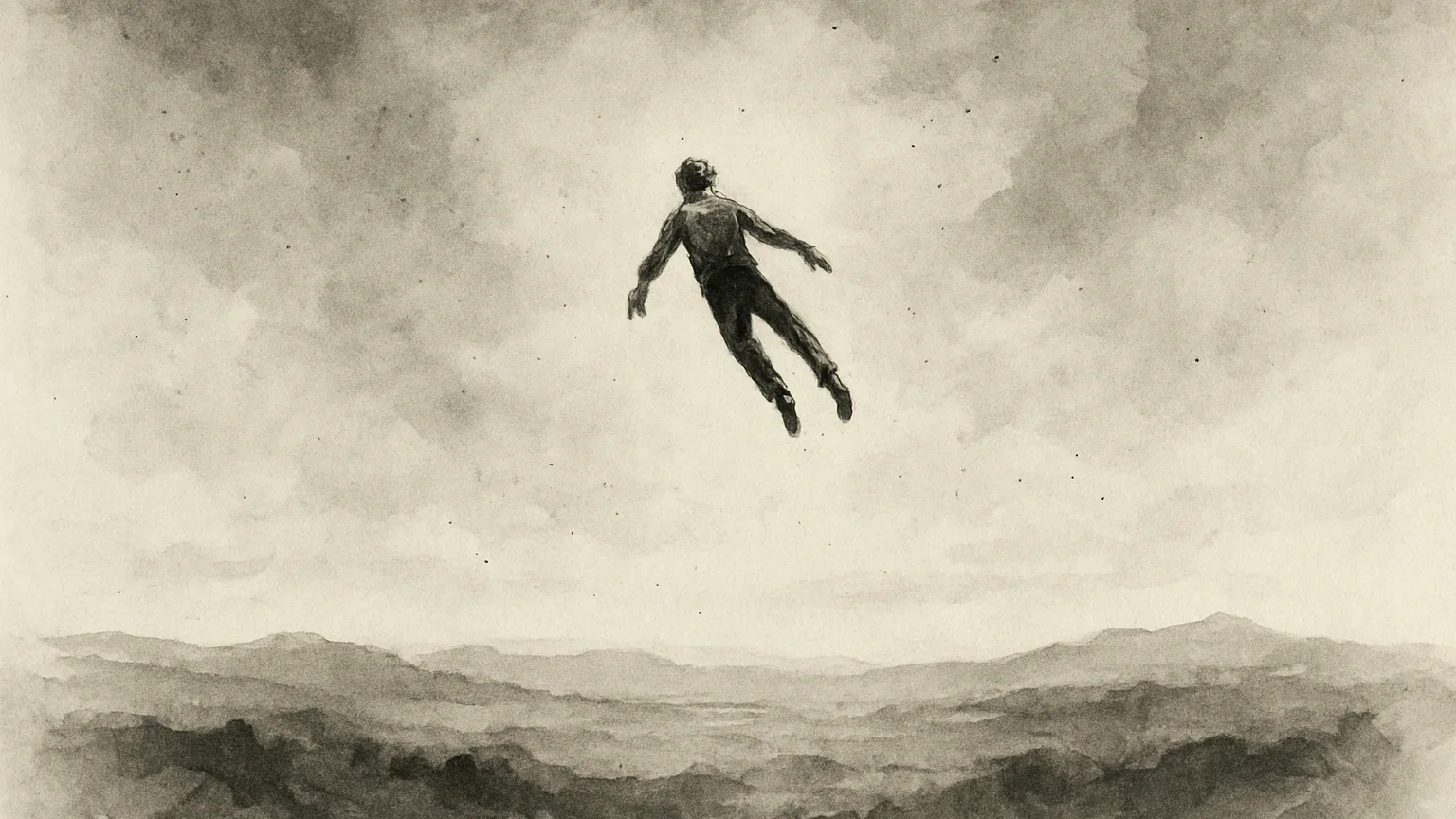
Dreams about falling are among the oldest and most widely reported dreams there are, and they almost never begin at the edge. The dream starts mid-air — the losing already underway — and what it carries is usually the feeling of support giving way somewhere in waking life. Where the ground went is the question it leaves with you.
What this dream might be about
The fear of falling may be the first fear you ever had. Newborns arrive with a startle reflex triggered by nothing except the sensation of being dropped — before faces, before darkness, before anything has been learned, the body already objects to losing its support. So when a dream reaches for the feeling of falling, it’s reaching for the deepest shelf. Whatever the dream is about, it wanted the strongest word available for it.
And notice what the dream skips. It almost never shows you the edge, the misstep, the moment of losing your grip — you simply arrive in the air, already falling, with the cause behind you and out of view. That may be the most honest thing about it. The losses this dream keeps company with tend to work the same way: the job was already ending before the meeting, the relationship had already shifted before the conversation. By the time you feel the fall, the ground went a while ago. The dream begins where the feeling begins — mid-air.
Language knew all this before any of us dreamed it. We fall behind, fall short, fall from grace, fall apart; power falls, markets fall, night falls. Falling is what we call nearly every loss that happens to us rather than by us — and that’s the thread running through most versions of this dream: something was holding you, and now it isn’t, and no one asked you first. Dreams of being unsupported tend to visit when support is exactly what’s in question — a role dissolving, a person withdrawing, a plan that was load-bearing revealing itself as guesswork.
There’s one distinction worth holding onto, because the body in the dream knows it even when the mind doesn’t: the difference between falling and flying is mostly consent. The same altitude, the same wind, the same distance from the ground — and one is terror while the other is release. Some falling dreams sit strangely close to that line, and if yours did — if some part of the fall felt almost like letting go — that ambivalence is information. Not every loss of ground is only a loss.
None of these readings is the meaning. They’re the places this dream tends to visit. Which one it visited in you is something only your night, and the life around it, can say.
Falling and jolting awake
The most common version, and the briefest: a step off a curb that isn’t there, a lurch, and you’re awake with your heart going. This one usually strikes right at the border of sleep, and it has as much to do with the body as the mind — the muscles spasm as you drift under, and the half-dreaming brain writes a one-second story to explain the sensation. It’s a dream the way a sneeze is a sentence. If your falling dreams are all of this kind, the practical note at the bottom of this page is really for you.
Falling from a great height
A rooftop, a cliff, a window on a high floor. Height in dreams is rarely just altitude — it’s position: the standing you’ve climbed to, the visibility that comes with it, the distance now available to fall. This version tends to find people who have something to lose and know it — a reputation, a role, a hard-won stability — and its arrival often says less about danger than about how exposed the height has started to feel. The higher the dream builds the ledge, the more it may be measuring what you’ve become responsible for holding up.
Falling without ever landing
No ground, no impact, no end — just descent that keeps unspooling until the dream changes or you surface from sleep. The dread in this version is not the landing but the absence of one: nothing to brace for, no moment after which the worst is known. It tends to keep company with situations that refuse to resolve — the diagnosis pending, the decision that stays undecided, the ending that won’t finish ending. If life has you suspended somewhere between the loss and the outcome, this is what that suspension feels like at night.
Being pushed
One detail, and the whole dream changes species. A fall is something that happens; a push is something someone did — and this version stops being about ground and starts being about trust. Sometimes the pusher has a face you know, and the dream is blunt about where the unsteadiness is coming from. Just as often the push comes from behind, from no one you ever see — and the dream may be saying only that this loss doesn’t feel like an accident, that somewhere you suspect a hand in it. Whose, it leaves to you.
The ground giving way
The floor opens. The stairs go soft. The elevator lets go, the bridge folds, the pavement simply isn’t there. In this version you never lose your footing — the footing loses you, and that difference is the whole dream. It tends to arrive when something structural, something you built on rather than merely held, has been called into question: the institution that was supposed to be permanent, the marriage that was supposed to be the floor, the certainty underneath all the other certainties. You did nothing wrong in this dream. That’s what makes it frightening.
Watching someone else fall
Rarer, and it stays with people. Someone you love is falling — sometimes near enough to reach for, never near enough to catch — and you wake with your arm still out. This version usually isn’t about your ground but about theirs: watching someone change, struggle, or slip somewhere you can’t follow, and meeting the hard limit of what your reaching can do. The dream borrowed the fall, but the helplessness is yours.
What matters more than the symbol
Here is the honest limit of a page like this one: the same fall lands differently in different lives. Falling the week your company announces layoffs is not falling the month after a divorce, and neither is the fall a new graduate has the night before the first day. A dictionary can tell you what a word tends to mean. It cannot tell you what the sentence meant — and the dream you had was a sentence, spoken once, in your voice, in the middle of your particular life.
No one can tell you what your dream means — including us. What the fall was doing in your night depends on what surrounded it: what you fell asleep carrying, what the air felt like — panic, or something quieter — whether you fought the fall or went still inside it, and what, if anything, you were falling toward. Those details are where the meaning lives, and they belong to you.
Before you go looking for meaning
One practical note. If your falling dreams strike in the first minutes of sleep and end in that full-body jolt, you’re likely describing hypnic jerks — a muscle spasm at the border of sleep that the drifting mind dresses up as a fall. They’re common and harmless, but they get louder with caffeine late in the day, irregular sleep, and stress, so a run of them is sometimes just your evenings asking for adjustment. That doesn’t empty the dream of meaning; the mind chooses its stories even when the body supplies the material. But it’s worth ruling out the simplest reading before reaching for the deeper ones. Sometimes a fall is just the body sitting down into sleep a little too fast.
Frequently asked questions
If you hit the ground in a falling dream, do you really die?
No — plenty of people land in falling dreams and wake up fine, sometimes after the dream simply continues. The idea that landing kills you is pure folklore, probably born from the fact that most dreamers wake before impact. Waking first is common; it isn't a survival mechanism.
Why do I jerk awake right as I start to fall?
That jolt is a hypnic jerk — an involuntary muscle spasm that happens as the body crosses into sleep, common enough that most people experience it. The falling sensation and the twitch arrive together, and the drifting mind wraps a one-second story around them: a curb, a stair, a cliff. It's more physiology than psychology, and it's harmless.
What does dreaming about falling usually mean?
The pattern most often reported is a link to lost support or lost control — dreams of falling cluster around times when something that was holding you steady has shifted: a job, a relationship, a plan, a certainty. But the same fall carries different weight in different lives, and only the life around your dream can say what was giving way.
Why do I keep having falling dreams?
Recurring dreams tend to circle something ongoing rather than something sudden. If the fall keeps returning, it's worth asking what in your waking life still feels unsupported — recurring dreams usually quiet down once the ground they're pointing at has been steadied, or at least named.