Dreams About Being Chased — What They Might Mean
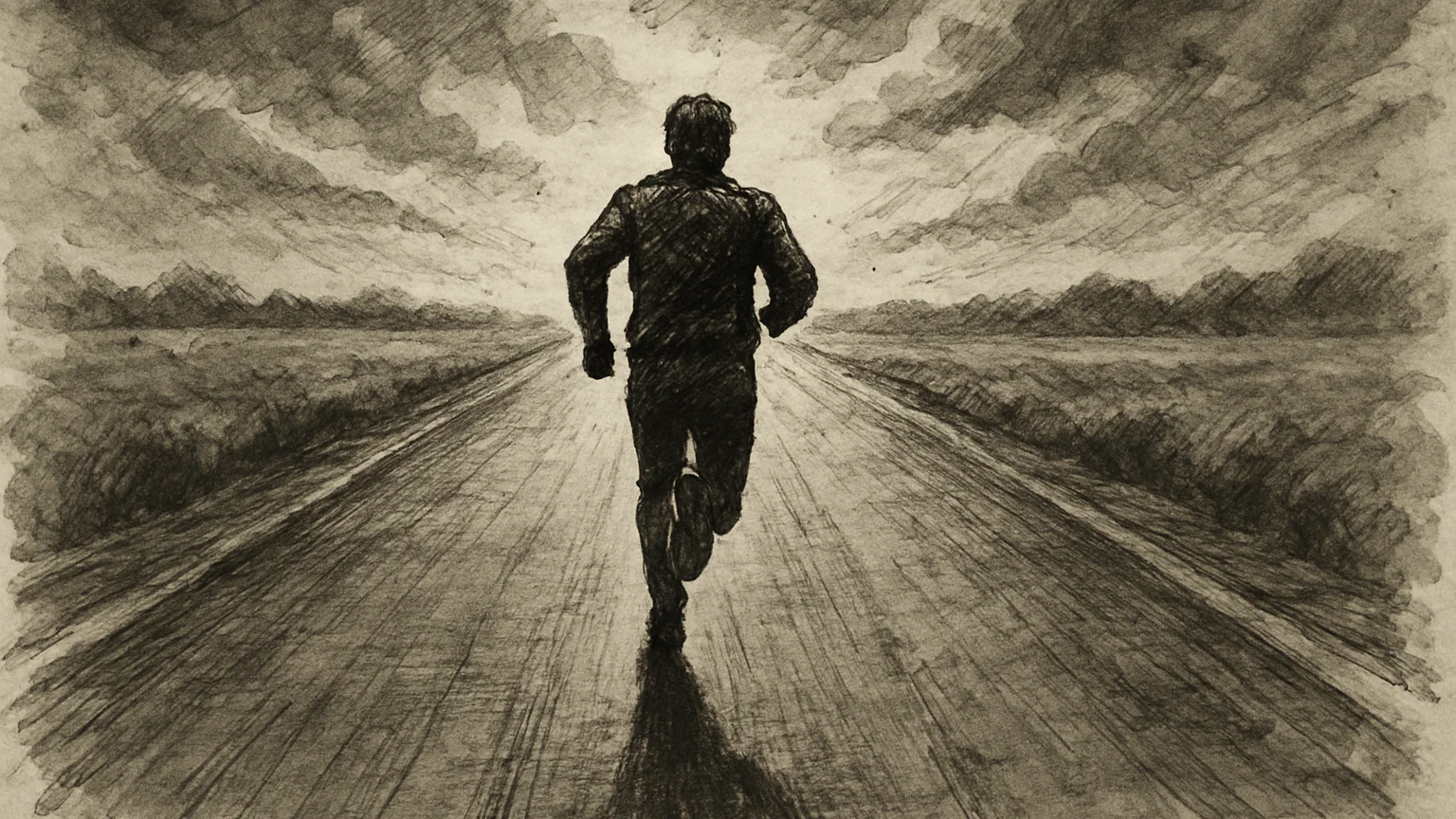
Being chased is the most common nightmare in the world, and it isn’t a warning that danger is near. These dreams tend to show up when something in waking life is being avoided — a conflict, a decision, a feeling — and the running is the avoidance, felt from the inside. Who or what is chasing you is usually where the meaning hides.
What this dream might be about
Fear needs a shape, and pursuit is fear’s simplest geometry: something behind you, gaining. That may be why this is the nightmare nearly everyone shares — children dream it before they can name what frightens them, and adults keep dreaming it long after they can. No other dream is so widely distributed and so uniform in its mechanics. The scenery changes; the physics never do.
The oldest and sturdiest reading is that the thing behind you in the dream is the thing in front of you in waking life. The conversation being postponed, the decision with no good option, the grief or anger that keeps getting rescheduled — the dream turns “I’ll deal with it later” into motion and makes you feel what the postponing costs. You can often tell how heavy the avoided thing is by how hard the dream works to keep it behind you.
Notice, too, what almost never happens: the catch. Chase dreams overwhelmingly end mid-stride — you wake at the last second, or the dream simply changes the subject. That’s a clue about what the dream is for. It was never building toward capture; the pursuer’s whole job is to keep you moving. The dream is about the running — the cost of it, the exhaustion of it, the impossibility of doing it forever.
And the casting matters. A stranger, a shadow, an animal, someone whose face you know — each gives the pursuit a different flavor, and an animal pursuer often carries its own long story with it. What ran after you, where you ran, and what finally made you turn or wake: that cast list is the dream’s actual script.
Your legs won’t run
The body’s oldest betrayal. You know how to run — you’ve done it all your life — and in this dream your legs have forgotten, moving through syrup, through sand, through air gone thick as water. The panic here isn’t really about the pursuer anymore; it’s about the machine failing at the exact moment it’s needed. If waking life has a place where you’re giving everything and barely moving, this dream knows the feeling from inside.
You try to scream and nothing comes out
You open your mouth and the dream takes the sound. Sometimes there are people nearby — that’s the cruelest version, help within reach and no way to call it. Dreams of the stolen voice often surface when something urgently needs saying and hasn’t been said, or when you doubt that saying it would change anything. The silence in the dream may be a question about the silence outside it.
A pursuer you never see
You never see it. That may be the design. A faceless or unseen pursuer stays faceless for a reason — the dread it carries hasn’t been named yet, and the dream can’t draw what you haven’t identified. These chases often feel worse than the ones with monsters in them, because a visible threat has edges and an invisible one is everywhere. When the pursuer finally gains a face, on some later night, that’s usually news.
Chased by someone you know
The strangest chases are the familiar ones. A parent, an ex, a friend, a boss — someone who has no business hunting you, doing exactly that. It’s tempting to read this literally, and occasionally the dream is about them. More often the person is a costume: their judgment, their expectations, the unresolved conversation that has their face on it. The dream borrowed a familiar face for an unfamiliar role, and the role is the part to sit with.
Hiding while it searches for you
The chase stops and becomes a held breath. Under the bed, behind a door, in a closet with footsteps coming closer — hiding dreams trade the panic of motion for the tighter panic of stillness. Hiding is postponement given a body: you haven’t escaped the thing, only paused it, and the dream knows the difference even when you’re pretending not to. Whether you’re found or the footsteps pass is often how the dream tells you what it thinks of the strategy.
You stop and turn around
The rarest version, and the one dreamers describe decades later. Something shifts — exhaustion, defiance, curiosity — and you stop running and face it. What happens next is remarkably consistent in the telling: the pursuer halts, shrinks, changes into something else, or simply stands there, suddenly unsure of its job. Turning around doesn’t always end the dream kindly. But it changes the question from “can I get away” to “what is this,” and that’s a different dream entirely.
What matters more than the symbol
Here is the honest limit of a page like this one: a map can show you every road out of a city. It cannot tell you why you were leaving. Two people can have the same chase — same dark street, same footsteps — and be running from entirely different lives. The dream’s mechanics are universal; what powers them never is.
No one can tell you what your dream means — including us. It depends on what only you were carrying into that night: who or what was behind you, whether anyone in the dream tried to help, what you felt in the last second before waking — terror, or something closer to being tired of running. That’s where this dream keeps its meaning, and it kept it for you.
Before you go looking for meaning
One practical note. During dreaming sleep, your muscles are genuinely switched off — the body is paralyzed so it doesn’t act out what the mind is staging. Some researchers think the leaden legs and the scream that won’t come are the dream noticing this: a story built around a body that truly cannot run or shout right now. Chase nightmares are also the most common nightmare of childhood, and for many people an adult version is simply an old track replaying under stress. None of that empties the dream of meaning. But before you go hunting for the pursuer’s name in your life, it’s fair to check the simpler reading first. Sometimes the chase is just the body, explaining itself.
Frequently asked questions
Why can't I run in my dreams?
There may be a physical reason. During dreaming sleep the body's muscles are switched off so you don't act your dreams out — and the leaden legs, the running through syrup, may be the dream noticing that your actual body can't move right now. The frustration is real, but it's often the body's condition showing through, not a comment on your life.
What does it mean if the thing chasing me catches me?
First: nothing bad about you or your future. Most chase dreams end before contact, so a dream that reaches the catch is unusual — and dreamers often find the moment transforms rather than destroys, with the pursuer changing, speaking, or dissolving. Being caught may simply be the dream finishing a sentence it usually leaves unfinished.
Is being chased in a dream a bad sign?
No. It's the most common nightmare on earth — the first nightmare many of us remember from childhood — and it appears more often during stressful stretches of ordinary life. It signals pressure, not danger. Nothing is coming for you because you dreamed that something was.
Why do I keep having chase dreams?
Chase dreams repeat more than almost any other kind, and the pursuer often changes costume while the chase itself stays identical. When that happens, the recurring part is usually the avoidance, not the monster — the same unfaced thing wearing a different mask each night. The dream tends to stop repeating once the running does.