Dreams About Tsunamis — What They Might Mean
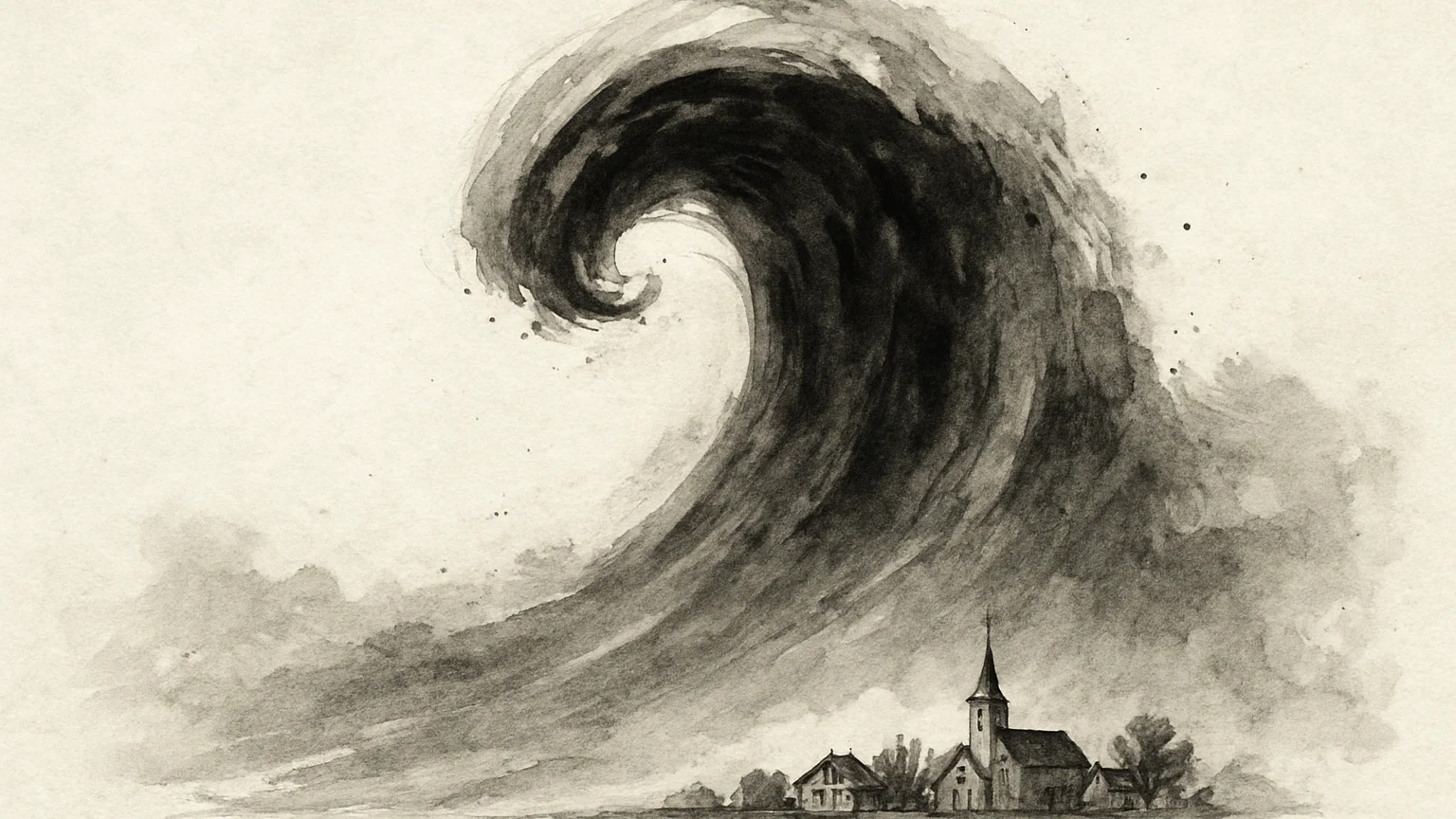
Dreams about tsunamis are one corner of a triangle: water rising slowly around you is one dream, going under is another — this is the third, the wave you can see coming. Its subject is overwhelming force known in advance, and everything the dream has to say happens in the interval between the seeing and the arriving.
What this dream might be about
What distinguishes a tsunami from every other water the mind dreams is not size — it’s notice. The flood climbs the stairs while you sleep; the undertow takes you from below; but the wave stands itself up on the horizon and lets you watch. There is a moment of seeing, an interval of knowing, and then the arriving — and the dream is almost never about the arriving. Tsunami dreams famously end before impact, or hold the wave impossibly suspended, because the impact was never the subject. The subject is the interval: what it is like to live inside the time between knowing something enormous is coming and its actually coming. If your waking life currently contains a known large thing in transit — the results due, the restructure announced, the ending both of you can see, the date circled on a calendar you’d rather burn — the dream has rendered your exact coordinates: on the beach, watching the horizon change shape.
The second thing the wave carries is disproportion. A tsunami is not a problem; it is a fact — too large for any response you could mount, indifferent to sandbags, unanswerable by effort. The dream reaches for it when what’s coming has outgrown the category of things you solve: not the difficult project but the diagnosis; not the hard conversation but the divorce; the change of scale that will rearrange the coastline of a life no matter what anyone does. Dreamers often report the strangest feature of the genre here — a stillness inside the fear, standing on the sand doing nothing, and hating themselves for it. Be gentler with that dream-self. Stillness before a tsunami isn’t paralysis of character; it’s the accurate response to a category error. The dream knows some things cannot be fought, only survived — and part of what it may be offering is permission to stop strategizing against the unstoppable and start deciding what to carry to high ground.
And then there’s the beach. The most haunting detail in tsunami dreams, reported over and over: nobody else reacts. The wave stands on the horizon, unmistakable, and the beach carries on — children digging, someone asleep on a towel, a volleyball game — while you point and shout into a wind that eats it. Sometimes the sea even pulls back first, the water withdrawing impossibly far, the dream borrowing real tsunamis’ actual warning sign — and still no one moves but you. This is the loneliness of private foresight, and it visits people carrying exactly that awake: the one who’s flagged the risk the company won’t act on, the family member who sees where the parent’s decline is heading, the partner who can feel the relationship’s horizon changing while the other insists on sunbathing. The dream doesn’t certify your forecast — anticipators are sometimes wrong, and part of the dream’s honesty is that the wave hasn’t landed. What it certifies is the isolation. You are alone with a seeing, and it’s heavy, and the dream knows.
None of these readings is the meaning. They’re the places this dream tends to visit. Which one it visited in you is something only your night, and the life around it, can say.
The wave on the horizon
The purest version: you look up, and the sea has changed its mind — a line where no line should be, growing, and the specific full-body understanding of what it is. The dream may go no further; often it doesn’t need to. This is anticipation distilled, and its arrival in your nights usually coincides with something entering waking life’s far field — recently learned news whose consequences haven’t landed, a change announced for next quarter, next year. The details worth keeping are your first three seconds: what you understood, what you looked for, who you thought of. Dreamers consistently report that the wave’s appearance came with instant, involuntary clarity about what mattered — and that clarity, more than the fear, is the part of the dream worth carrying back over the border.
Trying to warn them
The Cassandra version, covered above and deserving its own door because so many arrive searching it: shouting, pulling arms, pointing at the horizon while the beach declines to believe you. Sometimes the dream sharpens it cruelly — the people ignoring you are the specific ones you love, and you spend the interval failing to move them. This dream visits the designated worriers of families and workplaces, the ones whose role is to see ahead and whose curse is the credibility gap that comes with the role. Two honest notes: first, the dream renders your isolation, not your accuracy — hold the forecast itself to daylight standards. Second, if the dream recurs with the same unmovable people, it may be measuring something other than the wave: how much of your life is spent warning, and what it costs to be the one on the beach who can never just dig in the sand.
Running for high ground
The interval, spent: legs moving, the hotel stairwell, the hill behind the town — and the dream’s strange accounting of what you did with the minutes. What did you grab? Who did you grab? Dreamers remember these choices with documentary clarity — the child swept up, the stranger helped or passed, the object inexplicably clutched — and they’re the version’s real content: the wave forces a triage of everything, and the dream watches what makes your list. People facing genuine oncoming upheaval — a move, a loss, a verdict — often get this dream as rehearsal, and wake with an unexpectedly clear answer to a question they hadn’t asked: when everything can’t be kept, what do I carry? That answer tends to be reliable. The dream extracted it under pressure, which is when true answers surface.
The wave that never lands
Suspended — cresting and cresting, the sky gone green-dark, impact perpetually seconds away — or the dream simply ends, mid-interval, and you wake with the wave still standing. Like the fall without a floor and the moment before the diagnosis, this is the mind rendering suspension itself: a waking life parked between the knowing and the landing, where the dread has no completion date. It tends to visit the long waits — the drawn-out endings, the results that keep being next week, the geopolitical or climate dread that by design never resolves. The dream can’t land the wave because the life hasn’t. What it offers instead is recognition — this is genuinely one of the hardest places to live, mid-interval, and the dream, by returning there, is at least keeping you company in it.
It hits — and you’re still here
The rarest arc and the one dreamers report almost shyly: the wave arrives, the world goes white-green and thunderous, the dream does not cut away — and then it’s after, and you’re somehow still there. Wet, gripping something, rearranged, alive. Like the bullets that do nothing, this version is often the mind’s damage report filed in advance or in arrears: the enormous thing, survived — either rehearsed (you can live through this; here is your body doing it) or recorded (you did live through it; look). It clusters on the far side of actual upheavals, once the dust settles, and sometimes mid-crisis in people who are, to their own surprise, still standing. The dream isn’t minimizing the wave. It’s reporting the other fact, the one dread always omits: waves pass. Coastlines change and remain coastlines. So, apparently, do you.
Watching it hit from somewhere safe
Behind hotel glass, on the hill, impossibly aloft — safe, and watching it take the beach, sometimes with people on it, sometimes people you know. Distance transforms the dream: the fear curdles into something more complicated — helplessness, guilt, the specific wrongness of witnessing at a remove. This version tends to visit people watching an upheaval land on others while they stand exempt: the layoffs that took the team and skipped you, the disaster in a homeland watched from abroad, the crisis consuming a sibling’s life while yours holds. The glass in the dream is the honest detail — real, protective, and isolating at once. Survivor’s distance is a genuine position with a genuine ache, and the dream renders it without judgment. What you do with the exemption, awake, is the question it leaves on the sill.
What matters more than the symbol
Here is the honest limit of a page like this one: the same wave stands on different horizons. A tsunami dreamed the month before a verdict is not one dreamed in a long season of world-dread, and neither is the wave watched from behind glass by someone whose family lives where the news is happening. A dictionary can tell you what a word tends to mean. It cannot tell you what the sentence meant — and the dream you had was a sentence, spoken once, in your voice, in the middle of your particular life.
No one can tell you what your dream means — including us. What the wave was doing in your night depends on what surrounded it: what large known thing is actually in transit toward your life, how far the horizon stood, who was on the beach and whether they’d listen, and what you carried, or grabbed, or understood in the first three seconds of seeing. Those details are where the meaning lives, and they belong to you.
Before you go looking for meaning
One practical note. Of all disaster dreams, this one tracks the news most faithfully. Tsunami dreams rise measurably after real waves reach real coastlines — and around their anniversaries, when the footage resurfaces — because disaster imagery is exactly what the sleeping mind files and restages; a wave watched on a screen this week is the likeliest author of the one on your horizon tonight. Coastal dwellers and anyone raised on evacuation drills dream it at higher baseline rates for the same reason: the mind rehearses the threats it’s been told to rehearse. None of this empties the dream — the mind chose this footage for tonight’s feeling, and the feeling is yours. But rule out the newsreel before the omen. Sometimes the wave is just the one from the headlines, still making landfall in your sleep.
Frequently asked questions
What does dreaming about a tsunami usually mean?
The tsunami's signature is what the dream borrows: overwhelming force, seen in advance — a threat too large to fight and too visible to deny, with an interval between the seeing and the arriving. The pattern most often reported ties these dreams to exactly that waking structure: something enormous and known is coming — a verdict, an ending, a change announced but not yet landed — and the dream lives in the gap.
Why do I keep having tsunami dreams?
The recurring version tends to visit people who live in the interval — chronic anticipators, the ones whose minds run permanently a few weeks ahead, scanning horizons. If your waking baseline includes always bracing for the next large thing, the tsunami is your inner weather rendered accurately, and it will recur as long as the bracing does. It usually quiets when the anticipated thing finally arrives, or is finally set down.
Why does no one else in the dream see the wave or react to it?
That detail is one of the most reported features of tsunami dreams and usually the most personal: you see it, you point, and the beach carries on. It tends to render the loneliness of private foresight — carrying an awareness others don't share or won't credit: the problem you've flagged that no one's acting on, the change you can feel coming in a relationship or workplace while everyone else sunbathes. The dream isn't saying you're right. It's saying you're alone with the seeing, which is its own weight.
Is a tsunami dream a premonition of disaster?
No — dreams don't forecast disasters, natural or otherwise. Tsunami dreams do reliably rise after real ones appear in the news, and around their anniversaries, because disaster footage is exactly the kind of imagery the sleeping mind files and reuses. If you've recently watched a wave on a screen, that's the likeliest source of the one in your night. The dream is absorption, not warning.