Dreams About Money — What They Might Mean
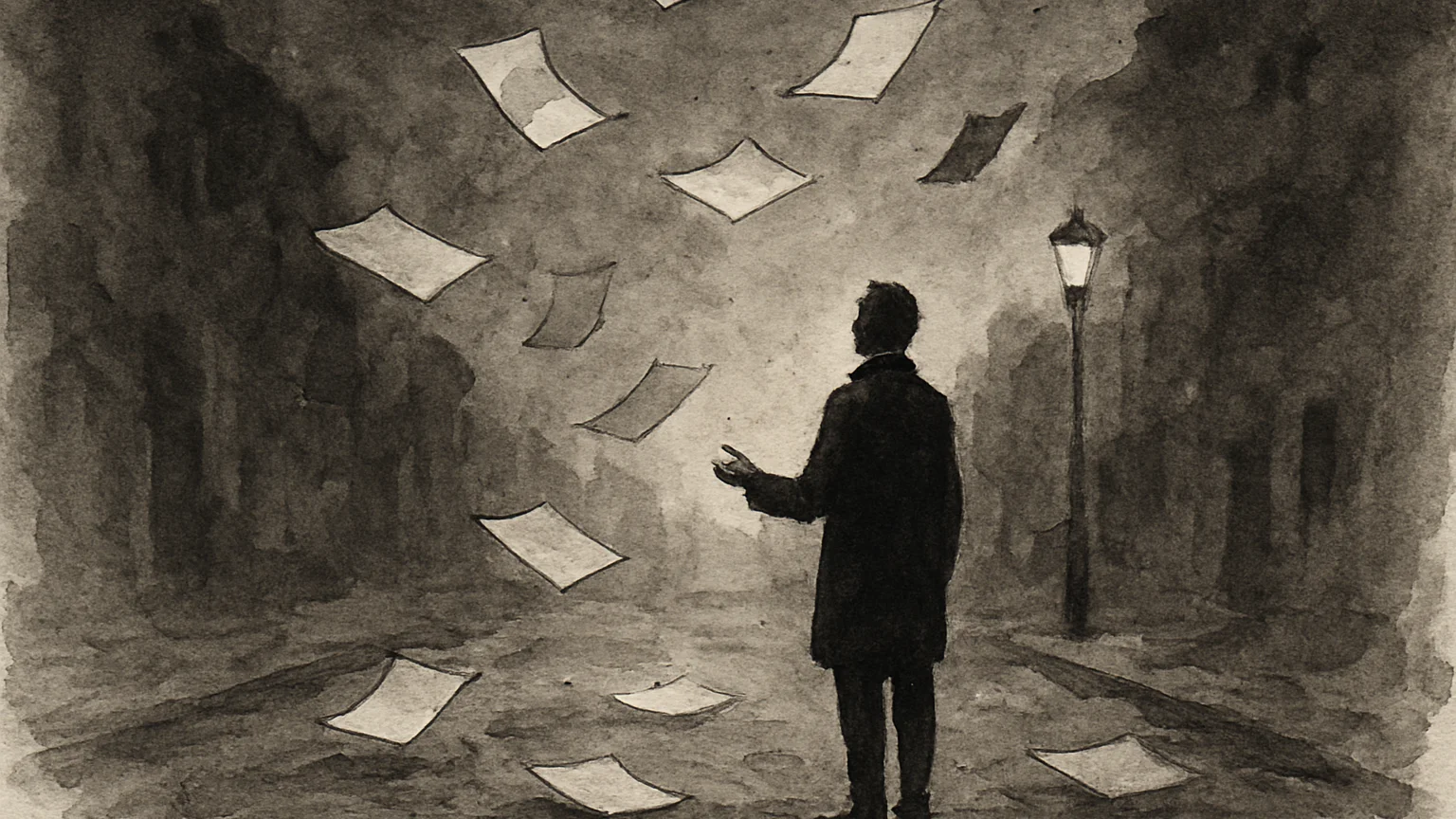
Dreams about money close this library on its most double-natured symbol: the one dream-object that is frequently exactly what it appears to be. In tight seasons, money dreams are about money, with unmatched fidelity. The rest of the time, they’re about the wider ledger — worth, resources, what you have to spend — and whether it covers what’s being asked.
What this dream might be about
Every symbol on these pages does double duty, but money’s split is the cleanest, so run the literal check first and honestly: is money currently loud in your waking life? Because no dream tracks its literal referent more faithfully than this one. Debt seasons, rent weeks, tax deadlines, the checking-account glance before bed — real financial stress writes money dreams almost one-to-one, in every register from the unpayable dream-bill to the miraculous dream-windfall, and interpreting those nights symbolically is mostly a way of avoiding the spreadsheet. The practical note below takes it further. But if the money in your life is quiet and the money in your dreams is loud — that’s when the symbol opens, and it opens onto the biggest ledger there is.
Because money, in the dream’s economy, is the unit of worth — and the dream spends it on every kind. What a person “has,” in the night’s accounting, includes everything spendable: energy, time, attention, standing, love, credibility, self-regard — and money dreams tend to be balance reports on that whole portfolio. Dreaming of wealth in a season when your bank account hasn’t changed usually means some other account has: recognition arriving, confidence compounding, a sense of finally having something to offer. Dreaming of poverty — empty pockets, small coins, checking and rechecking a sum that won’t stretch — tends to track the other movement: depletion, standing lost, the felt sense of having less to spend than life is currently charging. The idioms, as ever, arrived first: we pay attention, spend time, feel bankrupt and rich in ways no auditor could find. The dream stages the figures of speech — and its figures, unlike the bank’s, are usually accurate about the accounts that matter.
The sharpest version of that accounting is the can’t-afford dream — the check arriving at the restaurant, the till total climbing, the hand finding the pocket empty — because it renders the precise structure of a certain waking condition: demands presented, resources short, and the specific social heat of the gap being seen. This is insufficiency’s dream, and it visits far beyond finance: the job asking more than the energy account holds, the family’s needs exceeding the emotional balance, the season where everyone’s hand is out and the pocket is honest. It’s the drowning dream’s dry-land cousin — capacity exceeded, rendered as arithmetic instead of water — and it shares a diagnosis: the problem the dream is pointing at is rarely the bill. It’s the margin. Something in your life is running without one, and the dream keeps seating you at tables you can’t cover until the margin question gets an answer.
And one piece of dream-physics, worth knowing because it reframes half these dreams: money cannot be counted in dreams. Dreamers report it constantly — bills that change denomination mid-count, sums that won’t settle, the stack recounted five times with five totals — and it’s the same machinery that garbles clocks and text: the sleeping mind holds stable symbols badly, and numbers worst of all. So the maddening uncountability isn’t itself a message — but the dream, as it does with every glitch, recruits it meaningfully: the money that won’t be counted becomes the value that won’t be pinned — the worth you can’t get a stable read on, the deal whose real terms keep shifting, the self-assessment recounted nightly with different totals. If your dream was all counting and no conclusion, that’s often the content: somewhere, you are trying to establish what something — or someone, or you — is worth, and the figure won’t hold still.
None of these readings is the meaning. They’re the places this dream tends to visit. Which one it visited in you is something only your night, and the life around it, can say.
Finding money
On the pavement, in an old coat, in a drawer that was empty — and the small clean joy of it, sometimes escalating dream-logically: more bills, a trail of them, an envelope, a room. Found money belongs to the library’s discovery family — the kittens, the new rooms — and reads the same way: value of yours, surfacing. It tends to visit when worth is being revalued upward — the skill turning out to be rare, the confidence returning after a long discount, the realization that something you’d filed as ordinary (your patience, your eye, your years of some unglamorous practice) turns out to spend. Two details refine it: old money — in the coat, the childhood hiding place — leans toward recovered worth, value from an earlier self reclaimed; and the dreamers who look around to see if anyone’s watching before pocketing it are being shown a second thing, gently — the suspicion that their value isn’t legitimately theirs. It is. The coat was yours. So is what was in it.
Losing your wallet
The compound loss, as the FAQ holds — money, cards, and identity in one object, which makes the wallet the dream’s most efficient token of standing: what you can spend and who you can prove you are, gone in one pocket-pat. The dream usually stages the discovery moment — the reach, the absence, the cold cascade of everything now unprovable and unpayable — and it clusters around waking threats to the same bundle: the job wobbling (income and identity in one envelope), the credential questioned, the move or divorce or retirement that unbundles who-you-were from what-you-had. Note what the dream-self mourns first, because dreamers differ tellingly: the money, the cards, or the ID. That first grief is usually the accurate one — the part of standing that currently feels most exposed. And the version where the wallet is stolen rather than lost belongs partly to the next section, with its harder question of who.
The bill you can’t pay
The can’t-afford dream in full dress: the restaurant, the checkout, the counter — the sum announced, the pocket empty, and the room watching. Covered above as insufficiency’s dream; what belongs here is its social layer, because this version is never private — there is always a waiter, a queue, a table of others who could cover it, and the burn of the gap being witnessed is half the dream. It visits keepers of appearances especially: the ones maintaining a level — of lifestyle, competence, generosity — that the actual accounts no longer support, for whom the dream’s real dread isn’t the shortfall but the disclosure. Which contains the dream’s uncomfortable kindness: the exposure it rehearses is survivable, and cheaper than the maintaining. More than one dreamer has woken from the unpayable check and, in time, done the waking equivalent — said I can’t cover this out loud, to a boss, a family, a table — and reported the same thing: the room didn’t gasp. The margin came back. The dream stopped seating them there.
Being robbed
Taken, not lost — the mugging, the emptied account, the house entered and the valuables gone — and like the pushed fall and the stolen wallet, the agency is the reading: something of value is leaving your life by someone’s hand, or feels like it is. The candidates usually present themselves on waking: the partner whose spending is a slow leak, the job extracting more than it pays, the person whose presence costs — energy, confidence, years — the family arrangement where your account funds everyone’s withdrawals. The usual casting care applies doubly here, because money-resentment is combustible: the dream renders felt extraction, not audited fact, and waking certain someone is robbing you means the feeling predates the dream, not that the books confirm it. But felt extraction is real data about an arrangement. Somewhere, you believe an account of yours is being drawn down without consent. The dream has filed the complaint. The daylight question is whether the books agree — and if they do, what a boundary would cost, versus what its absence is costing.
Money that won’t count — or turns worthless
The uncountable stack, held above, and its crueler sibling: the found fortune that goes wrong in the hand — bills turning to paper, to leaves, to nothing, the classic fairy-tale gold that’s ash by morning. The evaporating-money dream trades in value that doesn’t hold: the promise that was going to change everything and quietly didn’t, the promotion that came without the substance, the relationship rich in everything except what it turned out to be denominated in. It tends to follow waking revaluations — the moment a thing long counted on is recounted and comes up short — and the dream’s fairy-tale lineage is apt, because the oldest stories used this image for the oldest lesson: some wealth is real only until examined. If something in your life recently turned to leaves in your hand, the dream is the receipt. And its forward-looking version — the windfall you suspect mid-dream, checking the bills against the light — is the healthy skepticism, rehearsing: something currently glittering is being offered to you, and part of you is already holding it up to the window. Let that part look.
The windfall
And one to end on — the library’s last variation, fittingly, is the one where something arrives: the lottery hit, the inheritance letter, the account impossibly full, the stranger paying the debt — and the dream’s flood of relief, sometimes so vivid the waking loss of it stings all morning. Two honest readings share this dream. In tight seasons, it’s the wish, dreaming — desire running the scenario the day keeps running, and worth exactly that much: real information about the wanting, none about the odds (the FAQ retires the folklore). But the windfall also dreams in another register, and it’s the one worth keeping: received value — being given to, covered, paid what you’re worth, rescued by generosity — and in that register it tends to visit people for whom receiving is the unpracticed skill: the coverers of every check, the ones who give and don’t take, the self-sufficient to a fault. For them, the dream isn’t about money arriving. It’s about letting something arrive — rehearsing, in the only currency the night had handy, what it would feel like to be on the receiving end for once. If the relief in the dream was out of all proportion to the sum: that’s the reading. The account that’s empty isn’t the bank’s. And unlike the lottery, that one pays out to anyone who’ll let it.
What matters more than the symbol
Here is the honest limit of a page like this one: the same money spends differently in different lives. An unpayable check in a genuinely tight year is not one dreamed by someone whose accounts are fine and whose energy isn’t, and neither is the windfall dreamed by the person who has covered every table they ever sat at. A dictionary can tell you what a word tends to mean. It cannot tell you what the sentence meant — and the dream you had was a sentence, spoken once, in your voice, in the middle of your particular life.
No one can tell you what your dream means — including us. What the money was doing in your night depends on what surrounded it: which of your accounts — bank, energy, standing, self-regard — is actually moving right now, what you found, lost, owed, or were handed, and what you felt at the moment of the transaction. Those details are where the meaning lives, and they belong to you.
Before you go looking for meaning
One practical note, and this page’s is the bluntest in the library: money dreams usually mean money. No symbol here tracks its literal referent more tightly — bill seasons, tax weeks, big purchases, thin months, and above all the banking app checked in bed write these dreams with near one-to-one fidelity, and the screen-before-sleep effect is real enough to test: a week without the balance-glance at midnight measurably quiets the genre. Financial stress also fragments sleep, which — as every page here has said — means waking mid-dream and remembering more of it: money worry produces money dreams and the recall to be haunted by them, a double bind with a single lever. So before the symbol, the statement — the literal one: is money loud in your life right now? Then the dream is the ledger, working nights, and the kindest interpretation is a budget, a conversation, or an advisor, not a dictionary. The symbols will keep. They always do. That’s the last practical note in this library, and it’s the same as the first: sometimes a tooth is trying to tell you about a tooth — and sometimes the money is just the money, asking to be counted in daylight, where the numbers hold still.
Frequently asked questions
What does dreaming about money usually mean?
Money is the dream's all-purpose token for worth and resources — not only cash, but everything a person has to spend: energy, time, standing, self-regard. The pattern most often reported splits cleanly: in seasons of real financial stress, money dreams are usually about money, with near-literal fidelity. Outside those seasons, they tend to be about value in the wider sense — what you have, what you're worth, and whether it covers what's being asked of you.
What does it mean to dream about finding money?
Found money is the dream's version of discovered worth — value that was there, unnoticed, now suddenly in hand — and it belongs to the same family as the found kittens and the new rooms: something of yours, surfacing. It tends to visit when worth is being rediscovered: a capability recognized, confidence returning, something about yourself revalued upward. It is not, per the folklore, a sign that actual money is coming.
What does losing my wallet in a dream mean?
The wallet is the dream's densest object — money, cards, and identification in one pocket-sized token of standing in the world — so losing it tends to render a compound loss: security and identity at once. It clusters around threats to exactly that bundle: job insecurity, status upheaval, seasons where who-you-are and what-you-have feel simultaneously in question. The panic in the dream is usually proportionate to how much of your footing currently runs through one vulnerable thing.
Does dreaming about money mean money is coming?
No — this is folklore's cheeriest dream claim and no truer than the rest. Dreams don't forecast windfalls, and lottery numbers received in dreams perform exactly at chance. Windfall dreams do rise in financially tight seasons, which tells you what they actually are: the wish, dreaming — desire running the scenario the day keeps running. That's worth something as information about the wanting. It's worth nothing at the counter.